The Discovery

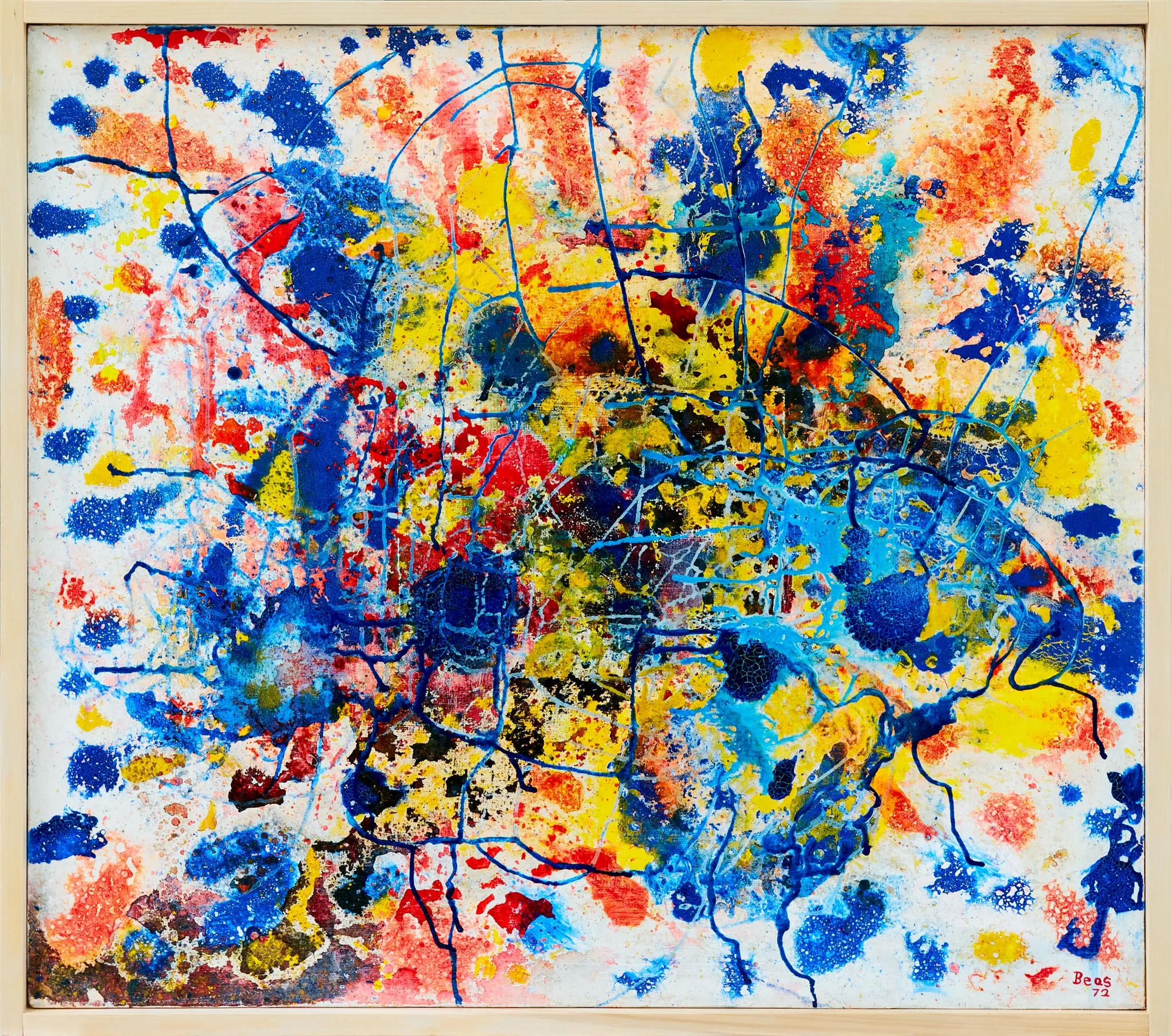
In 1971–72, when every paint tube warned “Do not mix oil and acrylic,” Beas pioneered the forbidden combination: what no artist had documented before — the systematic wet-mixing of oil and acrylic paints. A few artists had layered both media in single works; no one had deliberately mixed them together wet-into-wet — it violated every manufacturer guideline.
Beas made the chemical reaction itself his method. Oil is hydrophobic; acrylic is hydrophilic — one repels water, the other is carried by it. Repulsion, marbling, cellular formation: the behavior of these incompatible materials colliding on canvas became his visual language for the formation of matter — an imagery he has used across both series, and which he calls Abstract Quantum Fusion. What you are seeing is oil and acrylic reacting while wet — the collision, preserved.
Priority
Origin, not echo.
Beas begins systematic wet-mixing of oil and acrylic.
First documented artist globally to do so.
Sigmar Polke begins his celebrated material experiments.
Seven years later.
Anselm Kiefer begins his mixed-media period.
Nine years later.
In art history, dates settle arguments. An innovation is credited to its earliest documented, systematic practitioner — whether or not the work was seen at the time. Beas’s 1972 practice predates the celebrated material experiments of Polke and Kiefer by seven and nine years. This is precedence, not influence: the work was private. The record establishes what the collection is.
Verified by 131 pages of institutional-grade research — museum conservation records, exhibition catalogs, artist monographs, and primary sources in multiple languages. Full dossier available under NDA.
The Laboratory
The experiments survive.
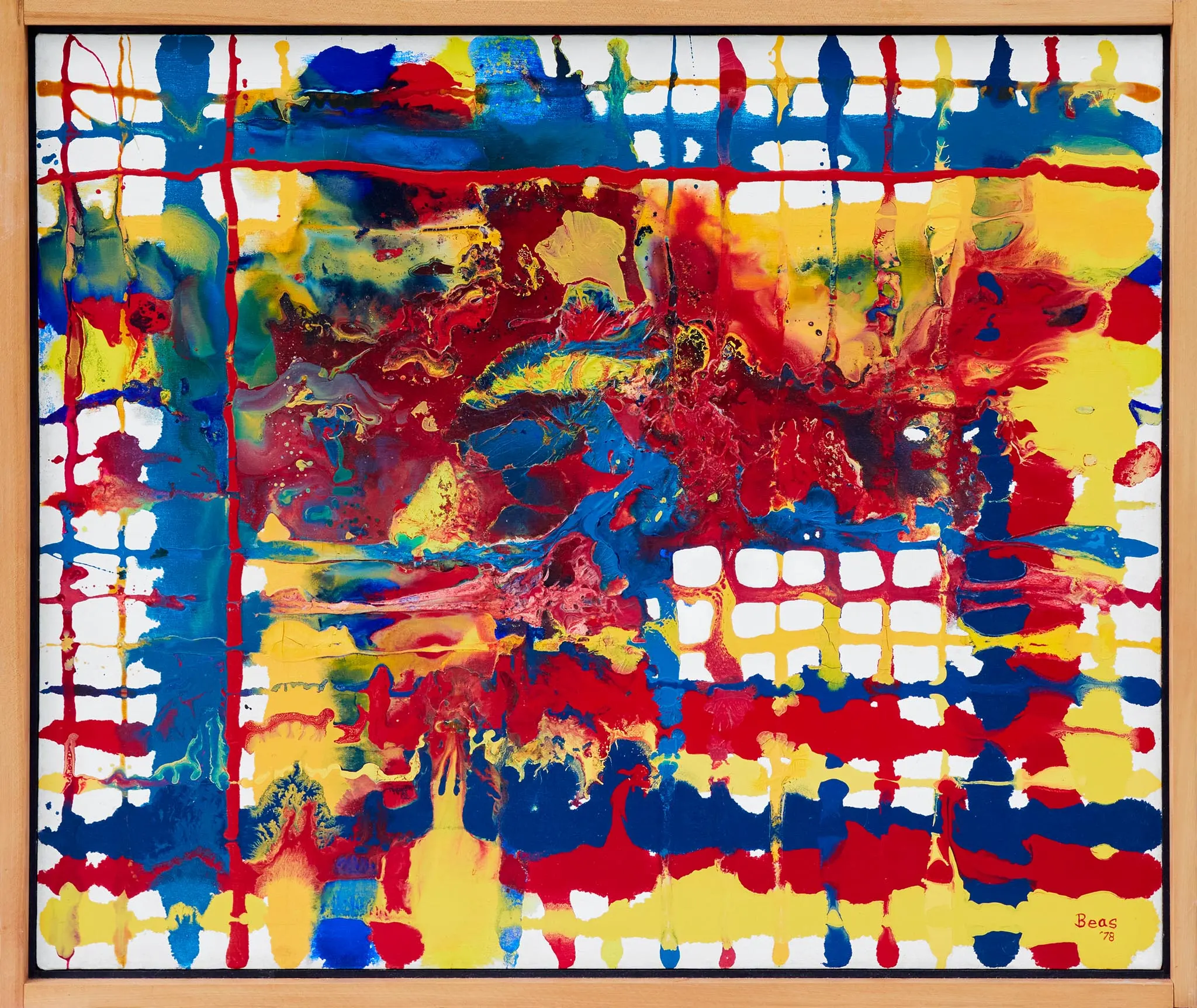
Before the Big Bang series existed, Beas ran the final experiments. Test One: twenty horizontal pours crossing twenty vertical — 400 intersections, each a recorded result. A painting that doubles as a laboratory record: the working evidence of the innovation, in the innovation's own medium. Both Test paintings remain in the collection.
The Instrument
An engineered instrument.
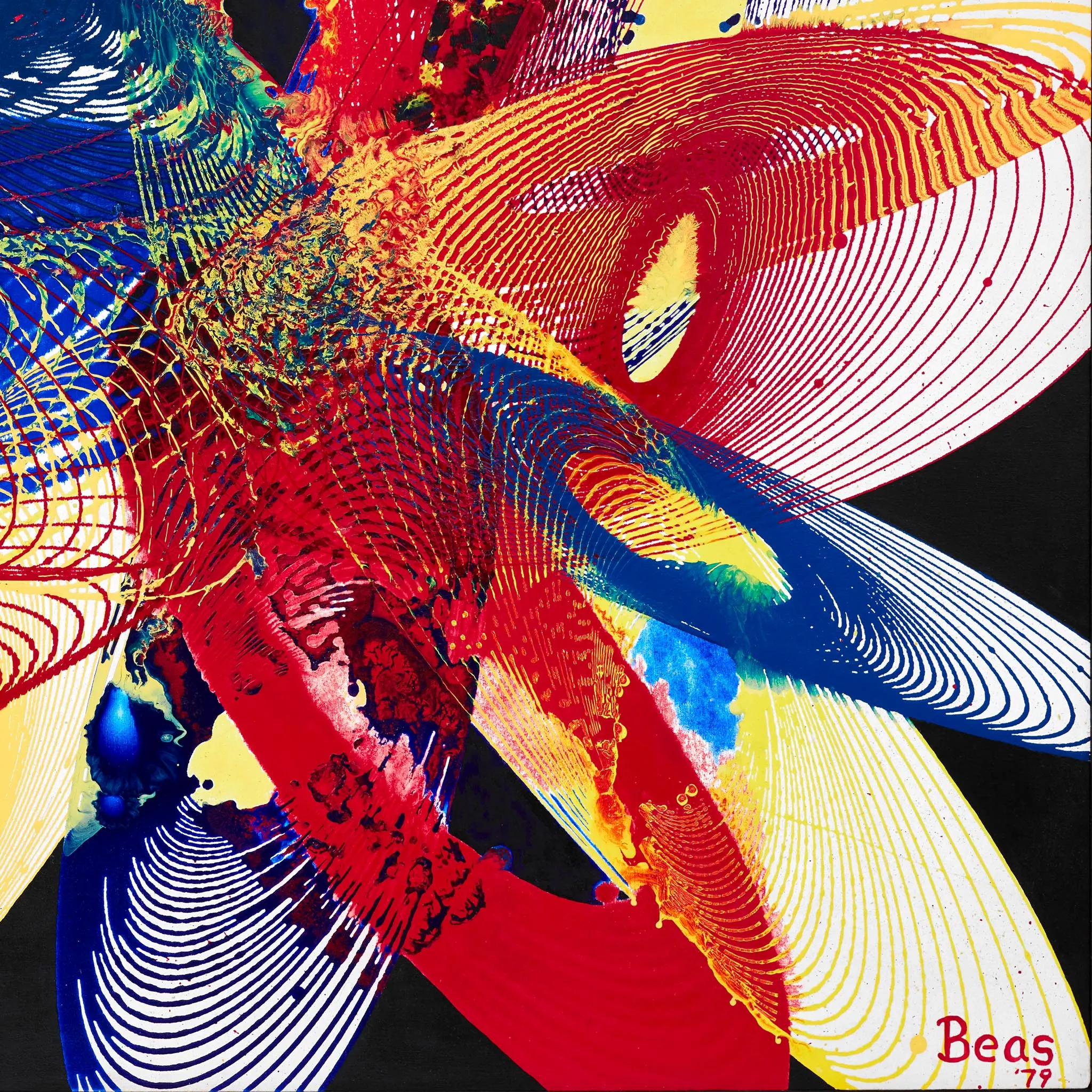
To deliver reacting paint to canvas with precision, Beas designed and built his own apparatus between 1974 and 1978 — a pendulum with a motor-driven piston controlling paint flow. The traces it left read as what they depict: orbital mechanics, decaying oscillations, the geometry of moving bodies.
The apparatus was his own invention, built in service of the chemistry — to put the reacting paints exactly where he wanted them. He used it as a method: ten paintings, one series, one device, each planned for months before paint ever touched canvas. The 1974 drawings survive in his notebooks; the instrument’s traces survive in the work.
It is the first documented engineered pendulum painting apparatus with precision paint-flow control. No instrument on record had combined engineered motion with controlled paint — until this one.